An Irrigation Investigation
Author
Target Grade Level / Age Range:
5th Grade
Estimated Time:
7, 30-minute periods and 8, 10–15-minute periods over the span of a month, varying with depth
Purpose:
Students will gather a deeper understanding of water as a natural resource including how much water is on Earth, the importance of water, and how agriculture uses water to grow crops. They will utilize the engineering design framework to design an irrigation system.
*Note, this lesson requires a basic understanding of fraction addition and multiplication. It is intended to be a practical application of this knowledge rather than an introduction.
Materials:
Activity 1
- Activity packet (1 per group of 3-4 students)
- Writing utensils
- Beach ball globe
- Dry erase board & markers/smartboard/chalkboard & chalk
Activity 2
- Activity packet (1 per group of 3-4 students)
- Irrigation Information Sheets
- Writing utensils
- Colored pencils/crayons/markers
- Poster paper
- Paper (for free draw)
Activity 3
- Projector/smartboard/format to display YouTube videos
- Activity packet (1 per group of 3-4 students)
- Vegetable Information Sheets
- Writing utensils
- Colored pencils/crayons/markers
- Large tote or box (Recommended: at least 10x20 inches, 6 inches deep) (1 per group of 3-4 students)
- Enough potting soil to fill each container nearly all of the way full
- Plugs (2 Bell Peppers, 5 Chantenay Carrots, 2 Marglobe Tomatoes, and 3 White Onions per group)
- Plastic cups
- Plastic bendy straws
- Clay
- Funnels
- Rubber bands
- Paper clips
- Ruler
- Dowels for tomato and bell pepper plants
- Popsicle sticks
- Posters
- Printer access
Essential Files (maps, charts, pictures, or documents)
- Irrigation Investigation Packet.pdf
- Irrigation Information Sheets.pdf
- Vegetable Information Sheets.pdf
Vocabulary
Activity 1
- Freshwater: any naturally occurring liquid or frozen water containing low concentrations of dissolved salts
- Irrigation: artificial application of water to the land or soil to assist plant growth
Activity 2
- Variable rate irrigation applies exactly the right amount of water to each foot/meter of the field
- Furrow irrigation: a type of surface irrigation where trenches are dug and then flooded between plant rows
- Drip irrigation: localized irrigation in which drops of water are delivered at or near the root of plants. In this type of irrigation, evaporation and runoff are minimized
- Sprinkler irrigation: water is distributed by overhead high-pressure sprinklers or guns from a central location in the field or from sprinklers on moving platforms
- Terrace irrigation: a series of steps are cut into the sloped land so that when it rains, the water flows down from the top step down to the succeeding steps retaining the soil nutrients as it goes
- Sub-irrigation: water is distributed across land by raising the water table, through a system of pumping stations, canals, gates, and ditches
- Topography: arrangement of the natural and artificial physical features of an area
Activity 3
- Specialty crop: fruits and vegetables, tree nuts, dried fruits, and horticulture and nursery crops
- Bar graph: graph of data in the form of vertical or horizontal rectangular bars
- Line graph: graph of information that changes consistently over time
- Histogram: chart that shows the distribution of data across a range of values
- Yield: measurement of the amount of a crop grown
Background – Agricultural Connections
The World’s Water
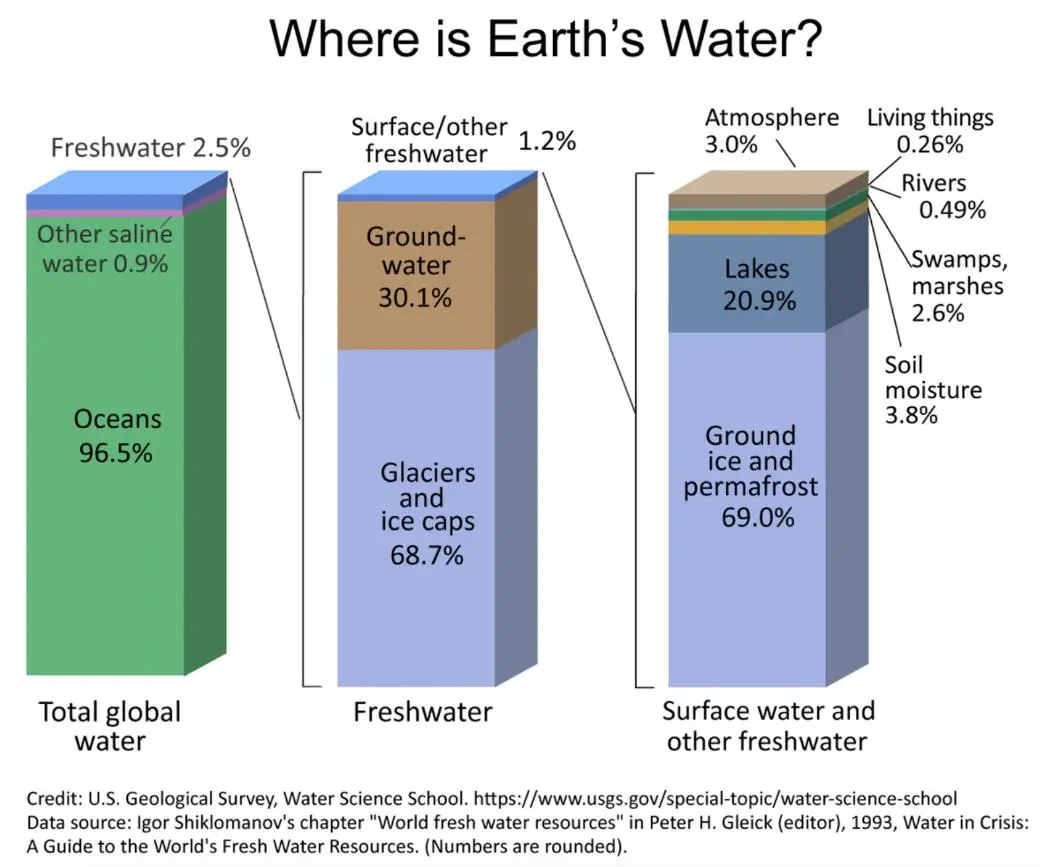
Over 70% of the Earth’s surface is covered by water, though only 2.5% of this water is considered freshwater. Only 2.5% of our water can be used for drinking, showering, and you guessed it, agriculture! In fact, around 70% of freshwater around the world is used for agriculture! Water is a limited resource that cycles through Earth systems. This is why irrigation and proper management of water use is important.
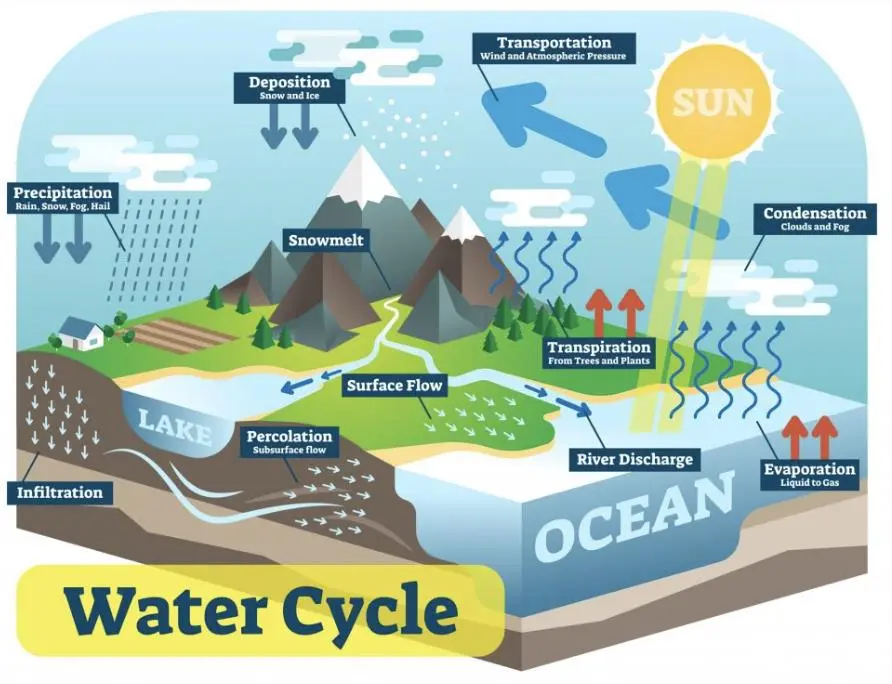
Credit: Australian Environmental Education
Irrigation
Irrigation has existed as an agricultural technology for thousands of years and is an integral part of growing crops. There are many different types of irrigation systems, although they each typically aim to serve the same purpose; conserving water by maximizing efficiency. However, this is not the limit of irrigation’s impact, irrigation can also be used to bring water to livestock in a process termed pasture irrigation. Regardless of the irrigation method, STEM (science, technology, engineering, mathematics) knowledge is essential to bring the system to life. Precise designs, measurements, and calculations are all necessary steps in developing an irrigation system. There are a variety of irrigation systems, but the most common are variable rate, sprinkler, drip, furrow, terrace, and sub-irrigation systems.
The variable rate irrigation system was first invented in the early 2000s by scientists at the University of Georgia's College of Agricultural and Environmental Sciences. This irrigation system functions by utilizing a center pivot irrigation system, rotating machinery that applies water to crops, and altering the amount of water applied to each part of the field. This is helpful because uneven topography, or elevation, can cause water runoff on areas of the land with high elevation. This results in areas that are too dry and areas that are too wet, leading to poor yields. This was important to the researchers at the University of Georgia because of Georgia’s dry climate and hilly terrain.
Today, variable rate irrigation systems are used in all types of climates, typically in areas with a range of elevations. Variable rate irrigation systems are used on each crop-producing continent, by numerous countries. Additionally, this system can be used with a large variety of crops, including specialty crops. Although this system may add a bit more complexity to a farmer’s current irrigation system, it is still in high demand due to its ability to precisely apply water, and thus conserve water.
The sprinkler irrigation system was first invented in 1894 by a farmer named Charles Skinner. However, the system didn’t become a possibility for most farmers until the end of the 19th century. This irrigation system functions by utilizing pumps, pipes, and sprinklers to spray water on crops in a way that mimics rainfall. The sprinklers can be located on the ground or on machinery that moves above the crops. This results in uniform application of water to all crops in a field, thus making it a good option for even, flat pieces of land.
Today, sprinkler irrigation systems are used in all types of climates, though they are more common in drier regions. They are also more common in areas with level land. Sprinkler irrigation systems are used on each crop-producing continent, by numerous countries. Additionally, this system can be used with a large variety of crops, including specialty crops. Although, this system should be avoided with delicate crops like lettuce, as the water droplets can damage the crop. This system is essential for farmers who live in arid areas or areas experiencing drought. This system helps farmers to conserve water by applying water evenly across their field, ensuring no water is wasted.
The drip irrigation system was first invented in 1959 in Israel by father-son duo Simcha and Yeshayahu. This irrigation system functions by providing the exact amount of water needed by a crop directly to the roots of the plant at the right time. This is helpful because uneven topography, or elevation, can cause water runoff on areas of the land with high elevation. This results in areas that are too dry and areas that are too wet, leading to poor yields. This system deposits water directly to the roots, eliminating runoff and this common issue.
Today, drip irrigation systems are used in all types of climates, typically in areas with a range of elevations. Drip irrigation systems are used on each crop-producing continent, by numerous countries. This system can be used with a large variety of crops, including specialty crops. This system conserves water by preventing runoff and evaporation through delivering water right to the roots of the crops. Today, it is highly praised for its ability to reduce the water needs of farms and increase the productiveness of their crops.
The furrow irrigation system is one of the oldest methods of irrigation; it was first practiced in Egypt and Mesopotamia. This irrigation system functions by supplying water to crops through shallow, evenly spaced furrows, or depressions in the ground. This is helpful for farmers in areas prone to flooding because they can slowly divert flood waters to the roots of crops, protecting the crops from being overwatered.
Today, furrow irrigation systems are used in areas prone to flooding, typically in areas that are relatively flat. Furrow irrigation systems are used on each crop-producing continent and by numerous countries. Additionally, this system is used commonly with row crops like cotton, maize, and sugar cane. This system conserves water by repurposing flood waters, thus reducing or eliminating the water a farmer applies to the crops.
The terrace irrigation system was first used by Wari culture and other peoples of the south-central Andes in 1000 AD. This system was also developed independently in other areas of the world, like in Southeast Asia. This irrigation system functions by creating “steps” on hillsides, held in place with a retaining wall. Each step is irrigated with water transported down the mountainside from springs, rivers, or reservoirs. This is helpful because uneven topography, or elevation, can cause water runoff on areas of the land with high elevation. This results in areas that are too dry and areas that are too wet, leading to poor yields.
Today, terrace irrigation systems are used in all types of climates, typically in areas with a lot of hills or mountains. Terrace irrigation systems are used in Southeast Asia, Africa, and South America. Additionally, this system is commonly used with rice, wheat, and barley crops. This system helps farmers avoid applying water to their crops, instead taking advantage of the natural resources that are already present. As a result, terrace irrigation can be an effective way to conserve water.
The sub-irrigation system was first utilized over 3000 years ago by the Aztec Empire in modern-day Mexico City, then called Tenochtitlan. The city was on top of a lake, so the Aztecs used the roots of plants mixed with dirt to create floating masses of land (called Chinampas) that were naturally watered from the lake beneath them. Just like the Chinampa, today this irrigation system functions by watering plants from the bottom, rather than applying water to the top, often by raising the water table. Farmers now can use captured water from runoff in their sub-irrigation systems, repurposing water from the environment.
Today, sub-irrigation systems are most commonly used in arid and semi-arid areas and areas with a naturally high-water table. Sub-irrigation systems are used widely throughout the world, notably in Florida and Pakistan. Additionally, this system can be used with a large variety of crops, including specialty crops. This system utilizes natural environments and processes to conserve water in agricultural production.
Interest Approach – Engagement
Ask students: “How often do you drive or walk past rivers or lakes? How about corn or soybean fields? Do you think there’s more water or land in Iowa? What about in the US? What about on Earth?”
Potential student answers:
- Depending on where students live, you may get varying responses. Ideally, students will notice there is more land than water in Iowa and the US.
- Students may or may not know whether there is more water or land on Earth, that is okay. The first activity will address this.
Procedures
Activity 1: How much water is on Earth?
1. Explore/Explain
a. *Prior to beginning this activity, you will want to create a chart visible for all students to see (chalkboard, whiteboard, smartboard, etc.). This chart can simply be two sections, each labeled for tallying either water or land.
b. Show students the beach ball globe and ask them;
i. What is a globe? What does it represent?
ii. What color do we usually use to represent water on Earth’s surface?
iii. What color do we usually use to represent land on Earth’s surface?
c. Have the students form a circle, leaving a little space between each other.
d. Instruct the students that they will toss the beach ball to each other and that they are to catch it with both hands, then freeze. It is important that they do not move their hands once they have caught the ball.
e. Ask the students what place on the globe is under their right thumb. Land or water? Use the chart to tally the results as the globe is tossed.
i. Students may have difficulty determining whether their thumb is over land or water, if it is on both, encourage them to choose whichever takes up the most space under their thumb.
f. After tossing the globe 100 times, ask the students to add up each side from the chart. Now analyze and discuss the results (there should be around 70 tallies for water and 30 for land, give or take some). Ask students, what do you notice about our data? Have students take another look at the beach ball globe and form observations about the amount of water on Earth.
i. Students should notice that the Earth is about ¾ water.
g. Introduce the concept of freshwater. Ask, how much of the water on Earth is freshwater? What is freshwater? Where can we find freshwater?
i. Students may or may not know this answer depending on their prior exposure to the topic. If they don’t know what freshwater is, encourage them to flip to the first page in their packet, as they spend time looking at the image, they should be able to understand where freshwater is found and differentiate it from salty, ocean water.
h. Students will do a think, pair (in groups of 3-4), share about potential issues the limited amount of freshwater presents to humans with a consideration of what human activities use freshwater.
i. When they pair in their groups, they will write down their thoughts on the first page in their packet.
ii. During the share portion, be sure to write student responses on the board as each group will likely have different answers.
iii. Students should mention, among other things, sufficient water for agriculture is a concern. If they don’t mention agriculture, ask, what type of water do our crops need? How much water do our crops need? Have you ever seen crops being watered?
i. Emphasize the importance of conserving freshwater, as it is a limited resource. Ask students if they have ever heard of irrigation, and if so, what they know about it.
j. After hearing their ideas, mention that irrigation is an important tool in conserving water.
Activity 2: Irrigation System Research
1. Engage
a. Students will do a quick reflection on the previous day’s activities. Ask students, why is freshwater important? How much freshwater does Earth have? What do we use freshwater for? What does irrigation have to do with freshwater?
i. Students should generally mention what they learned from the previous day.
2. Explore/Explain
a. Students are broken into groups of 3-4 and given an irrigation system from the Irrigation Information Sheets (variable rate irrigation, furrow irrigation, drip irrigation, sprinkler irrigation, terrace irrigation, and/or sub-irrigation). They will need to use the activity packet to record important information about their system in the note-taking guide.
b. Students will create a poster showcasing their irrigation system and each feature of the system.
c. Students will share their findings with the class (the posters should be hung in the room after this to help students with the next activity).
3. Evaluate
a. Students will complete a quick draw of their irrigation system, or the system of another group, and annotate the image with at least two important features of the system.
Activity 3: Irrigation System Planning, Design, and Evaluation
1. Engage
a. Play the YouTube videos below and prompt students to consider what problem these farmers were facing and how the use of an irrigation system improved their situation.
i. https://www.youtube.com/watch?v=OJ-QY00hdvU (0:00 – 1:33)
ii. https://www.youtube.com/watch?v=iuWoPLR-rpk (0:00 – 1:10)
b. After viewing the video, students will be given 3 minutes to do a think, pair, and share about the potential benefits of utilizing irrigation systems.
i. Potential student responses:
1. Students may have been unaware of how water intensive growing vegetables is and may point out that the effective use of water can allow farmers to conserve water (and money).
2. Students may point out that the farmers were able to increase their yields, and thus, their business became more profitable.
2. Explore
a. Students are broken into groups of 3-4 and given their engineering challenge.
i. There is a specialty crop farmer in their local community who wants to implement an irrigation system on their farm due to a long-lasting drought but needs the students’ help. They need to design an irrigation system that will effectively deliver enough water to each of the farmer’s crops while maximizing plant growth.
ii. Students have set parameters. Each group will have the same box, soil, and amount of sunlight. They will also have a set number of materials, time, and plugs to plant. You will need to inform students of this by either writing it on the board or discussing constraints with the students.
b. Students will use the Vegetable Information Sheets to find the amount of water required per plant per week. Each group will be assigned the same quantity and variety of vegetable plants. They will need to work together with their team to add the water amounts (in fractions).
i. This consists of Bell Peppers, Chantenay Carrots, Marglobe Tomatoes, and White Onions.
3. Explain
a. When analyzing the activity sheet and completing their calculations, students should notice some seeds require more water and some less. The variety of water intensive and less water intensive vegetables will require students to think carefully about where they plant each plug in relation to their chosen irrigation system. Students should develop a rationale for the location they decide to plant each plug at and how it is connected to their irrigation system design.
i. The activity packet has room for two experimental layouts and one final layout that the group will explain before moving on.
ii. Students will have plastic cups, plastic straws (with the bendable part), clay, funnels, rubber bands, paper clips, and other materials that students request.
1. Allowing students to have a few minutes looking at their supplies before planning can encourage them to think creatively.
4. Elaborate
a. Students will gather their materials and construct their irrigation systems.
b. Students will plant their plugs and begin implementing their irrigation systems. They will need to water the plants once each week (schedule with each group member rotating between the role of waterer weekly).
c. Over the next four weeks, students will take 10-15 minutes twice a week (Recommended: M/F) to measure the growth of their plants and digitally record the data in an excel sheet. Students will measure either the leaf or vegetable growth, whichever is visible. If both are visible, they should choose the vegetable. Students should begin recording in mm and transition into cm after two weeks.
i. Students should create a data table with each plant along the top row, and each day they take measurements along the left most column. Students can mark each plant’s location on the grid paper included in the packet and place numbered popsicle sticks stuck by each plant, so they are able to keep track of each plant and eliminate errors.
1. You may need to model this initial data table creation for students.

ii. Students will additionally record their data in the activity packet as a back-up in case data online gets lost or needs to be checked for accuracy.
5. Evaluate
a. After students take their final measurement, students will create graphs (bar chart, line graph, and histogram) to communicate their results. First, they will need to convert their mm and cm measurements into inches, so their information is easily understandable.
i. They will need to duplicate their table online and replace the measurements with their new measurements in inches.
b. Students will create graphs in Excel/Google Sheets showcasing the growth of each of their plants over time. Students will create two different types of graphs to showcase different aspects of their data.
i. A bar chart depicting the average growth of each vegetable type.
ii. A line graph depicting the growth vs time of any plant of their choosing.
iii. A histogram depicting the average growth from start to finish of one vegetable type.
1. You may also have to model this part for students. Helpful videos for students to understand each graph type are listed below.
a. https://www.youtube.com/watch?v=ReW4MPqXTvA
b. https://www.youtube.com/watch?v=n2YkbdNORp8
c. https://www.youtube.com/watch?v=haJyaQObNwU
c. Students will create a simple poster showcasing their methods and results. They should include:
i. The importance of water conservation and irrigation
ii. Their water calculations
iii. Their rationale for their irrigation system and planting locations
iv. How they designed their irrigation system
v. How their amount of water and irrigation system impacted the vegetables growth
vi. Their graphs
vii. A conclusion discussing the effectiveness of their methods, what they would do differently next time
d. Students' posters are displayed, and students travel to each poster to learn more about the other groups’ systems.
Did you know? (Ag facts)
- In 3100 BC, King Menes of Egypt created the first known irrigation system. That’s over 5000 years ago!
- Today, over 70% of today’s global freshwater is used in agricultural production!
Extension Activities
- Water Supply
- Journey 2050 Lesson 3: Water
- Learn, Protect, and Promote Water!
- Properties of Soils
- Soil Texture and Water Percolation
- Plant-Soil Interactions
- High-Tech Farming
Suggested Companion Resources
- Increasing Food Production with Precision Agriculture
- The Water Footprint of Food
- Journey 2050
- Dig In! Uncovering the Secrets of Iowa’s Veggie Farmers
Sources/Credits
Centers for Disease Control and Prevention. (2016, October 11). Types of agricultural water use. Centers for Disease Control and Prevention. https://www.cdc.gov/healthywater/other/agricultural/types.html
Vegetable gardening. Vegetable Gardening | National Agricultural Library. (n.d.).
https://www.nal.usda.gov/plant-production-gardening/vegetable-gardening
https://uiu.edu/academics/environmental-issues-instruction-eii/
Author(s)
Josie Mbaye
Organization Affiliation
Iowa Agriculture Literacy Foundation
Agriculture Literacy Outcomes
Agriculture and the Environment
- Identify land and water conservation methods used in farming systems (wind barriers, conservation tillage, laser leveling, GPS planting, etc.).
Science, Technology, Engineering, & Math Outcomes
- Describe how technology helps farmers/ranchers increase their outputs (crop and livestock yields) with fewer inputs (less water, fertilizer, and land) while using the same amount of space
Iowa Core Standards
Science
- 3-5-ETS1-1. Define a simple design problem reflecting a need or a want that includes specified criteria for success and constraints on materials, time, or cost.
- 5-ESS2-2. Describe and graph the amounts and percentages of water and fresh water in various reservoirs to provide evidence about the distribution of water on Earth.
- 5-ESS3-1. Obtain and combine information about ways individual communities use science ideas to protect the Earth’s resources and environment.
Mathematics
- 5.MD.A. Convert like measurement units within a given measurement system.
- 5.MD.B. Represent and interpret data.
- 5.NF.A. Use equivalent fractions as a strategy to add and subtract fractions.